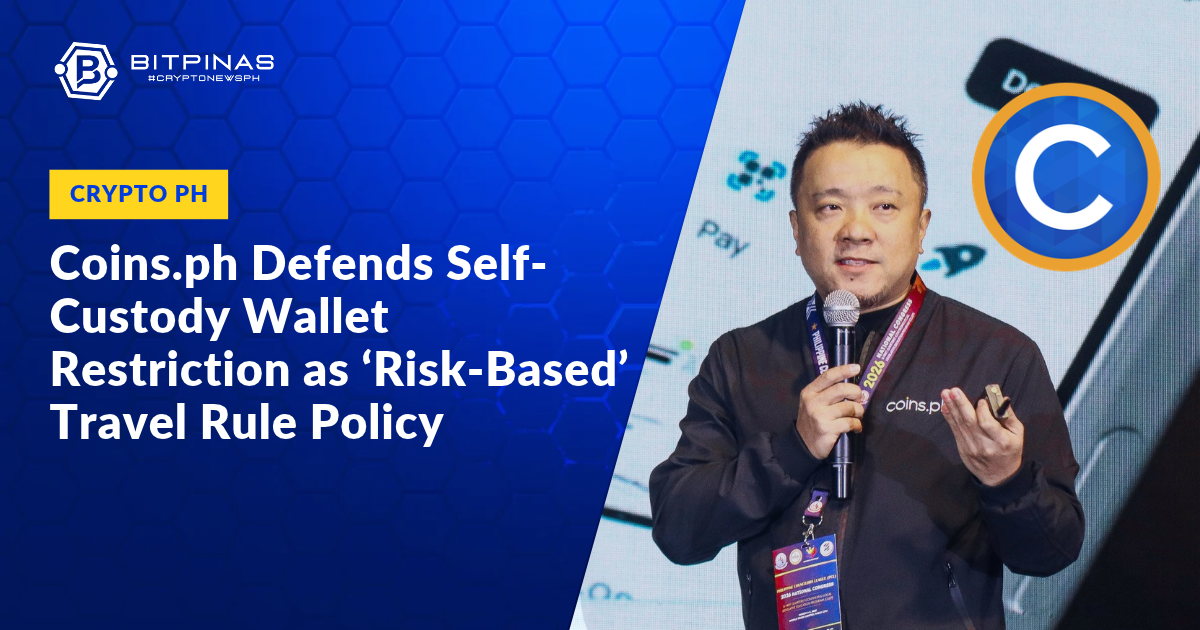
Localy licensed cryptocurrency exchange Coins.ph issued a formal statement on Nov. 24 defending its prohibition on direct self-custody wallet transfers as a “risk-based implementation” of Bangko Sentral ng Pilipinas (BSP) Travel Rule regulations.
The statement arrived five days after the platform halted direct on-chain crypto deposits and withdrawals with unhosted wallets on Nov. 19, restricting external digital asset transfers exclusively to accounts at other regulated exchanges. While an earlier user notice stated that the changes were required by regulation, the Nov. 24 release acknowledged that BSP rules require enhanced due diligence for unhosted wallets rather than an outright statutory ban.
Regulatory Framing and FATF Guidance
Under the BSP Travel Rule framework, licensed virtual asset service providers (VASPs) must obtain and transmit originator and beneficiary data for cryptocurrency transfers and conduct enhanced due diligence on transactions involving unhosted wallets. Coins.ph stated that limiting transfers to regulated pathways with verified counterparty information fulfills the core objectives of increasing transaction transparency and curbing illicit financial activity. (Read More: Philippine Crypto Regulation Tracker: Official Frameworks, Circulars, and Regulatory Actions (2026 Reference))
To support its policy, Coins.ph cited the Financial Action Task Force’s (FATF) July 16, 2026 Seventh Targeted Update on Implementation of the FATF Standards on Virtual Assets and VASPs, which identified peer-to-peer transfers via unhosted wallets as a structural anti-money laundering gap due to the absence of a regulated intermediary.
However, the July 2026 FATF report did not recommend prohibiting self-custody wallet transfers, instead calling on authorities and private firms to strengthen risk-based supervision, blockchain analytics and Travel Rule enforcement. In its October 2021 Final Guidance on virtual assets, the FATF also removed an earlier draft proposal that would have barred regulators from licensing exchanges transacting with unhosted wallets, leaving restrictions on self-custody as a discretionary risk-management choice for individual platforms rather than a regulatory mandate.
User Impact and Industry Reaction
In its latest updated, Coins.ph requires users to submit Travel Rule sender or recipient details for every on-chain deposit and withdrawal regardless of transaction amount. Inbound deposits identified as originating from self-custody wallets are rejected and returned to the sending address minus applicable blockchain network fees, while outbound withdrawal attempts to unhosted wallets automatically fail.
Coins.ph CEO Wei Zhou previously told BitPinas that both local and regulated international exchanges qualify as supported platforms under the policy.
The restriction drew criticism from local industry figures following its rollout, including Pouch CEO Ethan Rose, who stated that self-custody was “under attack in the Philippines”.
“Coins.ph recognizes that this marks a significant adjustment in how users move digital assets, but we believe it is necessary to safeguard the Philippine crypto ecosystem,” the company said in its Nov. 24 statement.
Broader BSP Supervisory Context
The policy shift builds on BSP Circular No. 1108, issued in 2021, and BSP Memorandum No. M-2023-042, issued in 2023, which require licensed VASPs to screen counterparties and reject transfers when minimum originator or beneficiary data is incomplete.
The updated cryptocurrency transfer rules also follow separate central bank enforcement involving Coins.ph’s fiat payment operations.
On Sept. 29, 2026, Philippine Payments Management Inc. implemented BSP Monetary Board Resolution No. 839, partially suspending inbound InstaPay and PESONet peso transfers for Coins.ph’s electronic money issuer operator, DCPay Philippines Inc.. Outbound peso withdrawals, retail QRPh payments and cryptocurrency operations under licensed VASP Betur Inc. remained active, and Coins.ph confirmed to BitPinas on Oct. 16, 2026, that all of its BSP licenses remain in good standing.
Disclosure: AI has been used to assist in developing and researching for this article.
This article is published on BitPinas: Coins.ph Defends Self-Custody Wallet Restriction as ‘Risk-Based’ Travel Rule Policy
What else is happening in Crypto Philippines and beyond: