Key Takeaways
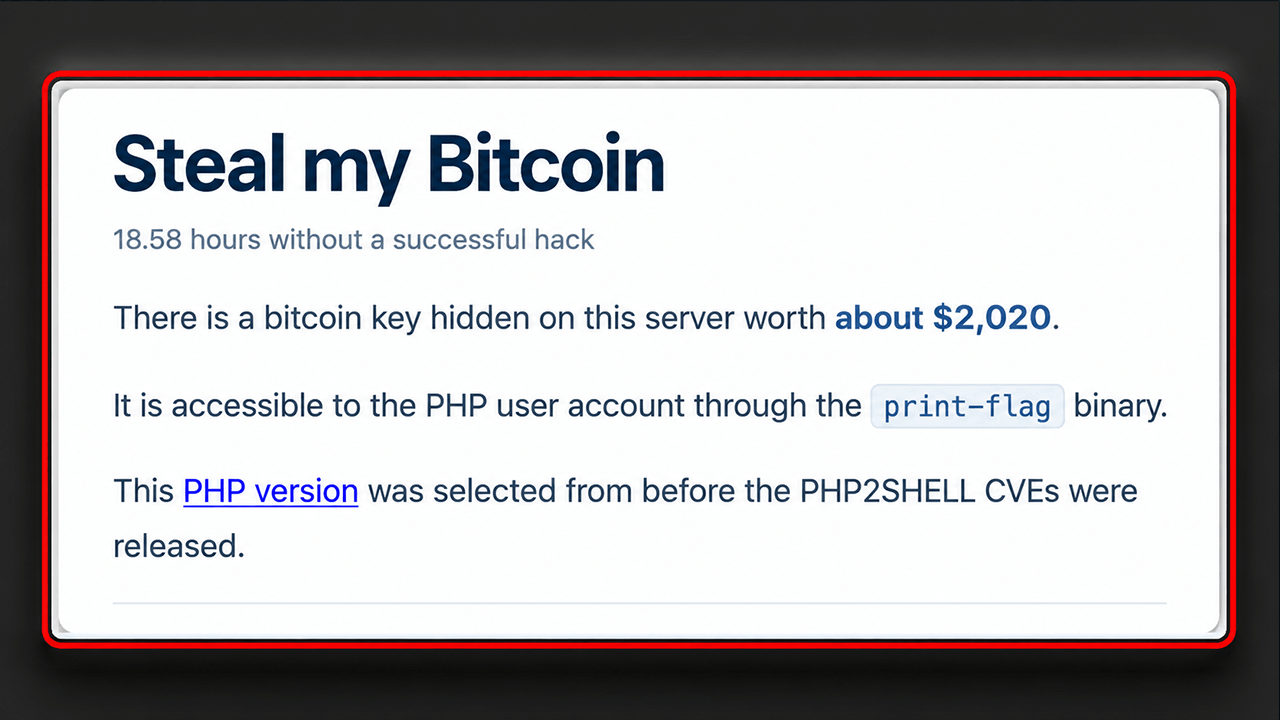
- Steal My Bitcoin’s roughly $2,000 bounty reportedly remained unclaimed after more than 17 hours.
- One individual suspects Steal My Bitcoin’s server configuration might prevent the intended PHP2Shell exploit.
- PHP2Shell’s two critical vulnerabilities are genuine, but the researcher’s challenge-specific theory is unverified.
A $2,000 Bitcoin Heist Nobody Can Pull Off
Welcome to Steal My Bitcoin, where cybersecurity’s usual rules have been turned upside down. Instead of keeping hackers out, the website invites them inside, offers a bitcoin bounty and dares them to take it. The mission sounds ridiculously simple: Exploit a deliberately vulnerable PHP installation, retrieve a hidden Bitcoin private key and empty the wallet. First successful hacker takes the money.
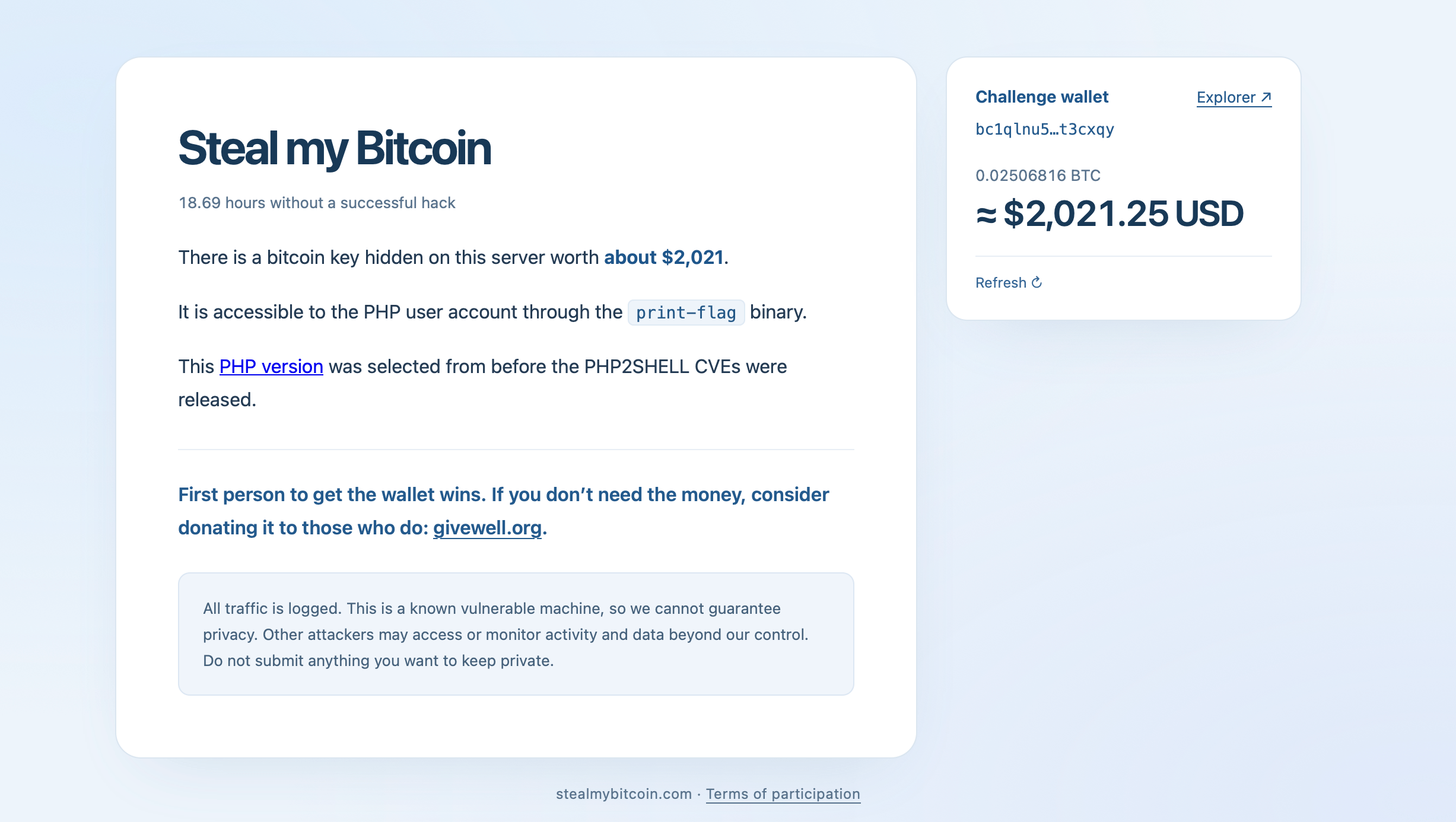
The prize started around $500 before donations pushed it toward $2,000, approximately 0.025 BTC. As of late Oct. 25, 2026, the wallet reportedly remained untouched after more than 17 hours online. There are rules, however. Participants must restrict their attacks to the web application and PHP container. Attacking the underlying host, sabotaging infrastructure or overwhelming the server is forbidden. All activity is logged.
Two Critical PHP Flaws Meet an Unexpected Roadblock
The challenge advertises PHP 8.4.26, a version vulnerable to two critical security flaws collectively dubbed PHP2Shell. Both carry severity scores of 9.2, and emergency patches arrived Oct. 21.
The vulnerabilities, CVE-2026-109618 and CVE-2026-109619, involve memory-management failures that can potentially permit remote code execution. In certain configurations, attackers could execute commands without authentication. But here’s where the story takes a peculiar turn.
One individual who examined the challenge publicly questioned whether its configuration actually exposes an exploitable attack surface. The individual identified nginx and PHP 8.4.26 through HTTP response headers, independently confirmed a PHP 8.2-or-newer fingerprint and compared the server’s behavior against local test environments.
After initially considering nginx paired with PHP-FPM or Apache, the analysis pointed toward something unexpected: The closest behavioral match appeared to be nginx forwarding requests to PHP’s built-in command-line web server.
Is the Bitcoin Bounty an Impossible Challenge?
The analysis raised an even more provocative possibility concerning the website’s entry point. Its responses appeared consistent with PHP’s built-in server delivering a static index.html file rather than executing an index.php script. If that interpretation is accurate, the advertised vulnerabilities might not be reachable through the challenge’s permitted attack surface.
That would fundamentally change the competition. Hackers wouldn’t necessarily be failing to exploit two critical bugs. They might be attacking an environment where the required conditions never materialize. The person behind the examination questioned whether the challenge was operating in good faith but acknowledged the findings could be mistaken and welcomed corrections.
Importantly, response fingerprinting alone cannot establish the server’s complete architecture or prove exploitation impossible. Still, the hypothesis remains unverified. Meanwhile, the underlying PHP vulnerabilities are real, and administrators running affected versions still need to patch their systems.
For now, Steal My Bitcoin presents an increasingly curious spectacle: A publicly advertised bitcoin bounty, a crowd of would-be hackers and a growing suspicion that the digital vault might not have an accessible door in the first place.